
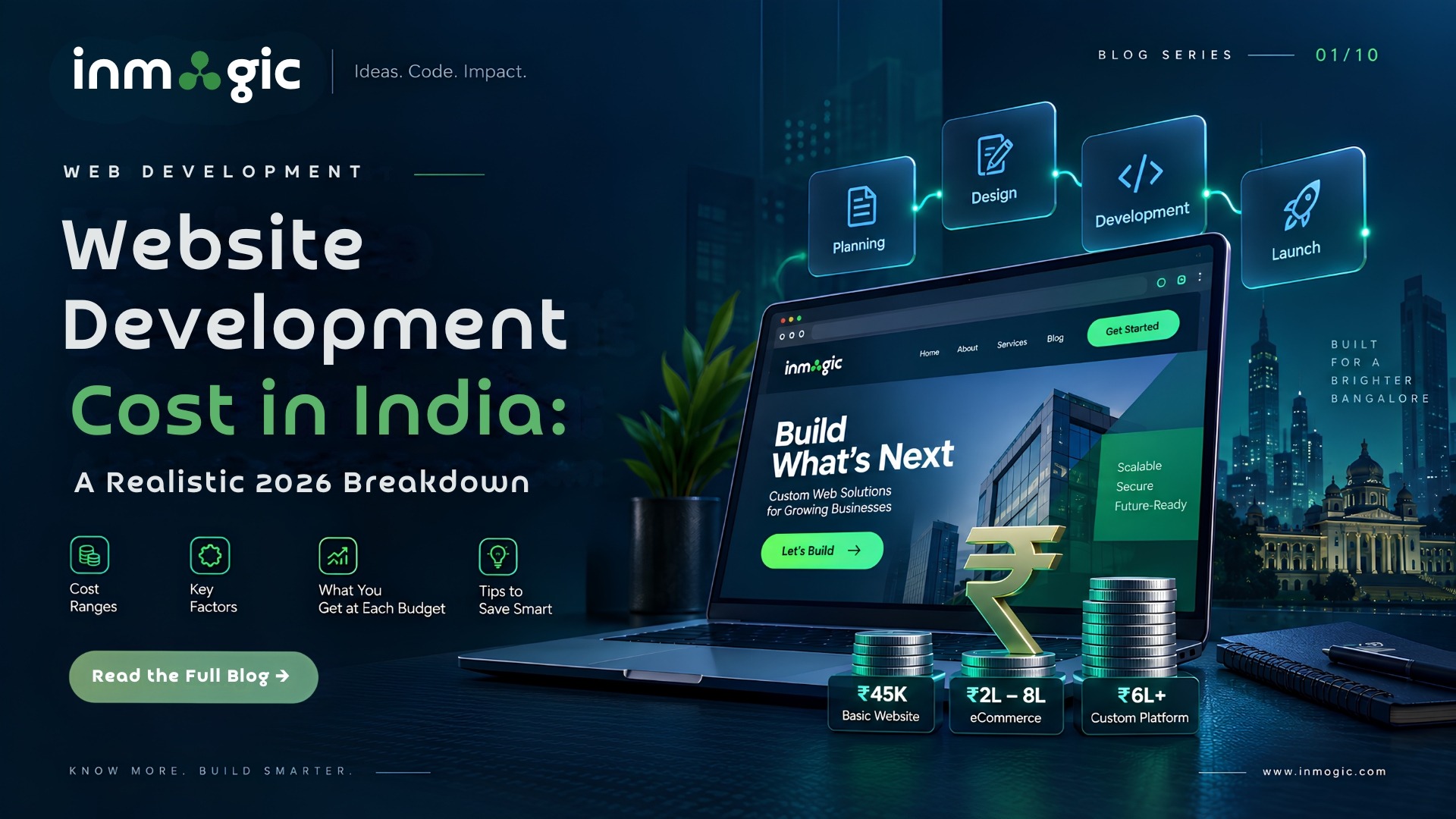
Answer first: in India in 2026, a professional business website typically costs between Rs 45,000 and Rs 3,50,000 for a standard corporate or brochure site, Rs 2,00,000 to Rs 8,00,000 for an eCommerce store, and Rs 6,00,000 upwards for a custom web application. The range is wide because “a website” describes anything from a five-page template build to a multi-language platform with live inventory and payment integration. This article explains exactly what moves the number, so you can read a quote and know whether it is fair.
What a website costs in India in 2026, by type
These are market ranges based on what mid-tier Indian development firms quote in 2026 – not our rate card, and not the cheapest number you will find. Freelance and offshore quotes sit below this band; large consultancies sit well above it.
| Type of Website | Typical Range (INR) | Usual Timeline | What You Get at This Level |
|---|---|---|---|
| Basic business / brochure site | Rs 45,000 - Rs 1,20,000 | 3 - 5 weeks | 5-10 pages, CMS, contact forms, mobile responsive, basic SEO setup |
| Corporate / multi-service website | Rs 1,20,000 - Rs 3,50,000 | 6 - 10 weeks | 15-40 pages, custom design, blog, careers module, integrations, schema |
| eCommerce store | Rs 2,00,000 - Rs 8,00,000 | 8 - 16 weeks | Catalogue, cart, payment gateway, order management, inventory sync, eCommerce development |
| Booking or portal-driven site | Rs 3,00,000 - Rs 10,00,000 | 10 - 18 weeks | Live availability, user accounts, third-party APIs, transactional email |
| Custom web application | Rs 6,00,000 upwards | 12 - 24 weeks+ | web application development with role-based access, database architecture, reporting, and ongoing releases |
Figures are indicative market ranges for 2026 and vary by city, agency tier and scope. Always get a written scope alongside any number.
The seven things that actually move the price
Two quotes for “a company website” can differ by four times, and usually it is not because one firm is greedy. It is because they scoped different work. These are the seven variables that do the moving.
1. Page count and template count - not the same thing
Twenty pages built from three reusable templates costs far less than eight pages each designed individually. When you compare quotes, ask how many unique designs are included, not how many pages. This single question explains most price gaps.
2. Custom design versus a customised theme
A theme customised to your brand is faster and cheaper, and for many businesses it is genuinely the right answer. Custom design costs more because someone is drawing every screen from scratch. The honest test: if your requirements fit what a good theme already does, paying for custom design buys you distinctiveness, not function.
3. Integrations
Every external system you connect - payment gateway, CRM, ERP, WhatsApp API, booking engine, accounting software - adds development and testing time. Integrations are the most commonly underestimated line in a website budget, because each one carries edge cases that only appear in testing.
4. Content
Most delays and a surprising amount of cost come from content. If you supply finished copy and images, you save money. If the developer writes copy, sources photography and builds a content structure from scratch, that is real work and it gets billed. Decide upfront who owns this.
5. Number of languages
A second language is not a translation job - it is a second content structure, second URL set, hreflang configuration and ongoing editorial workload. Budget roughly 30-50% of the base build for each additional language, and more if the languages use different scripts.
6. Performance and SEO requirements
A site that simply works costs less than a site engineered to load in under two seconds on a mid-range phone with clean structured data. Speed and search readiness are engineering decisions made during the build, not features added afterwards - which is why retrofitting them later usually costs more than including them from the start.
7. Who is building it
A freelancer, a five-person studio, a mid-sized firm and a global consultancy will quote wildly different numbers for identical scope. What changes is the depth of the team behind the work: whether there is a QA process, whether anyone answers the phone eight months after launch, and whether the code can be handed to another developer without a rewrite.
The costs most quotes leave out
The build price is not the total cost of ownership. Budget for these separately, because they recur every year whether anyone mentioned them or not.
Domain: Rs 800 – 2,500 per year
Hosting: Rs 3,000 – 60,000 per year, depending on traffic and whether you need managed hosting
SSL certificate: often free with hosting; Rs 3,000 – 15,000 per year for extended validation
Maintenance and security patching: Rs 3,000 – 25,000 per month. Unpatched CMS installations are the single most common cause of hacked Indian business websites
Content updates: either your team’s time, or a retainer
Premium plugins and licences: Rs 5,000 – 50,000 per year for page builders, booking systems, security tools
A useful rule of thumb: annual running cost typically lands between 15% and 25% of the original build cost. If nobody has raised this with you, ask before signing.
Why the cheapest quote is usually the most expensive
A Rs 15,000 website is not a smaller version of a Rs 1,50,000 website. It is normally a stock theme with placeholder content replaced, no performance work, no structured data, no testing beyond the developer’s own browser, and no plan for what happens when a plugin update breaks the layout.
The cost surfaces later, and it surfaces in a predictable order: the site loads slowly on mobile, it never ranks, the enquiry form silently stops sending, and eighteen months in you may need a website redesign to fix problems that could have been avoided from the start. The second build costs more than the first one would have, because now there is a migration to handle as well.
This is not an argument for the most expensive quote. It is an argument for reading what is inside the number.
How to budget sensibly
Write the requirement before asking for prices. Page count, integrations, languages, who supplies content, and what the site must do that your current one does not. A vague brief guarantees quotes you cannot compare.
Ask every vendor to quote the same scope. If one quote excludes content and another includes it, you are not comparing anything.
Separate build cost from running cost in your budget from day one.
Hold back 10-15% for post-launch changes. Every project has them. Planning for them is cheaper than treating each as a change request.
Ask what happens in month seven. The answer tells you more about the firm than the price does.
What we would recommend
If your website is a credibility asset – people check it before they call you custom web development services in the Rs 1,20,000 to Rs 3,50,000 band can buy a site that will hold up for four or five years.
If your website is a revenue channel, where enquiries or orders come through it directly, the calculation changes entirely: the build cost stops being an expense and starts being measured against what each additional lead is worth.
We build in both bands and will tell you honestly which one your requirement sits in, including when a smaller engagement is the right answer.