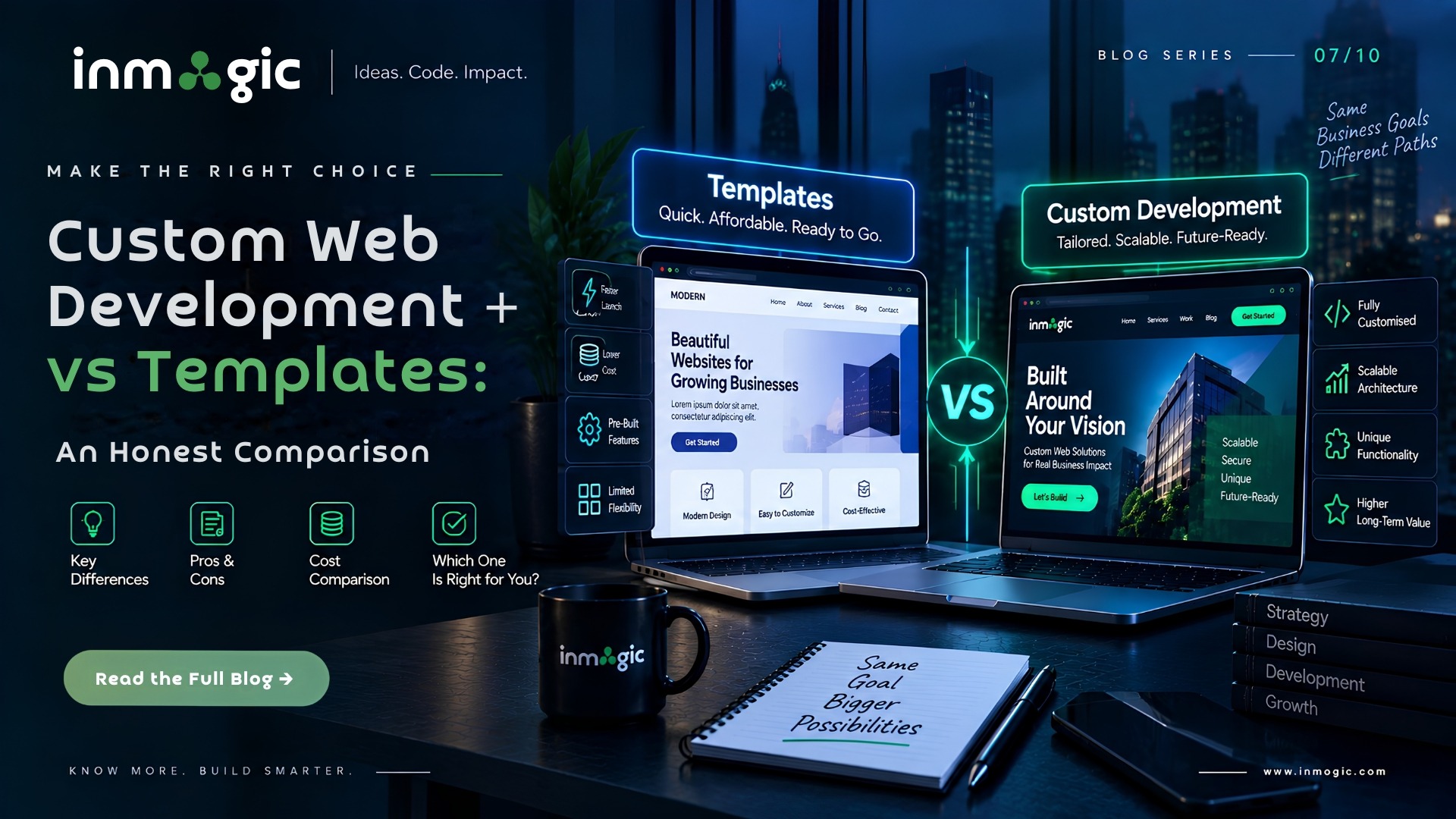
Custom Web Development vs Templates: An Honest Comparison
A customised theme is the right choice when your requirement is standard, your budget is constrained and speed to launch matters more than distinctiveness. Custom web development is the right choice when you have workflows, integrations or compliance requirements a theme cannot accommodate – or when the website is a revenue channel rather than a credential. Most businesses are honestly better served by one of these than by the one they assumed they needed.
We build both. This comparison is written to help you decide, including the cases where the cheaper option is the correct one.
What Each One Actually Means
Before comparing custom website development services with templates, it helps to understand what you are actually buying.
| Comparison | Customised Theme | Custom Development |
|---|---|---|
| Starting point | A pre-built theme, restyled to your brand | A blank file and your requirements |
| Design freedom | Within the theme's structure | Unrestricted |
| Typical cost | Rs 45,000 - Rs 1,50,000 | Rs 1,50,000 - Rs 8,00,000+ |
| Typical timeline | 3 - 6 weeks | 8 - 20 weeks |
| Page weight | Heavier - themes ship code for features you never use | Lighter - only what you need is built |
| Unusual requirements | Plugin workarounds, or not possible | Built directly |
| Long-term flexibility | Constrained by the theme and its updates | Extends as the business changes |
| Dependency risk | Theme or plugin abandoned by its author | Your codebase, your control |
If you are comparing these options mainly on website development cost, the template route usually wins initially. But the initial build price is only one part of the decision.
When a Customised Theme Is Genuinely the Right Answer
There is a tendency in this industry to treat “custom” as automatically superior. It is not. It is more appropriate for some requirements and wasteful for others.
A theme is the better choice when:
- Your site is primarily informational – services, about, contact and blog.
- You need to launch within a month.
- Budget genuinely constrains the decision, and spending it all on the build leaves nothing for content or marketing.
- Your requirements match what good themes already handle well.
- This is a first website and the business model may change. Overbuilding early is a real risk.
A well-chosen theme, properly customised, optimised for speed and set up correctly for search, will serve many businesses well for three or four years.
Anyone who tells you otherwise is selling something.
When Custom Development Pays for Itself
Custom development becomes easier to justify when the website needs to do something beyond displaying information.
Your Workflow Is Not Standard
A dealer portal, an approval chain, a quote configurator or another workflow that mirrors how your business specifically operates may require web application development rather than a collection of plugins. When the website needs to behave like a business system, building the required functionality directly can be more reliable than forcing a theme to handle it.
You Need Real Integrations
Live ERP inventory, a CRM two-way sync, a booking engine or an internal legacy system can introduce complexity. Plugin-based integrations may work for simple requirements, but they can become fragile when several systems need to communicate in real time.
Measurable Performance
Performance Is Commercially Material If a one-second delay costs you conversions, theme overhead becomes an expense rather than a saving. A custom build can focus development resources on the functionality and performance characteristics that actually matter to your users.
The Site Is a Revenue Channel
When enquiries, bookings, leads or orders arrive through the website directly, the development cost should be measured against revenue rather than simply against the price of a cheaper alternative.
You Have Compliance Requirements
Data handling, accessibility standards and sector-specific disclosure obligations can influence how a website needs to be designed and developed. In these cases, having greater control over the codebase can make it easier to implement requirements correctly.
The Hidden Cost of the Theme Route
Two costs often surface later and are worth knowing about before making a decision.
Plugin Sprawl
Themes handle standard needs. Each non-standard requirement often gets another plugin.
Fifteen plugins in, you can end up with a website that is slower, has a larger security surface and becomes more difficult to maintain.
Updates can also create compatibility issues between plugins, themes and the CMS.
This is not an argument against plugins. It is an argument for understanding how much functionality you are actually adding to the website.
The Ceiling
Every theme has a point beyond which it cannot go without fighting its original structure.
Reaching that ceiling in year two means either living with the limitation or rebuilding.
And rebuilding at that stage can cost more than custom development would have initially because you now have migration, redevelopment and potentially SEO considerations to manage.
This is not an argument against themes. It is an argument for being honest at the start about whether your requirement will eventually reach that ceiling.
The Middle Path Most People Miss
The choice is not always binary.
A headless or hybrid build uses a proven CMS for content management – so your team can edit content without a developer – while a custom-built frontend provides greater design and performance control.
For businesses considering this approach, CMS development can provide the content-management foundation while the frontend is developed around the site’s specific requirements.
You get the editing experience of a CMS, the speed and freedom of a custom frontend, and less lock-in than either extreme.
It costs more than a theme and less than a fully custom platform, and for a growing business it can be a sensible middle ground.
It is also the option least often presented because it requires the development team to be comfortable working across both CMS and custom development environments.
Five Questions That Settle It
If you are still unsure about website template vs custom development, answer these five questions.
1. Will Anyone Log In Besides Your Content Editors?
If customers, dealers, employees, partners or other users need their own accounts and dashboards, that points towards custom development.
If only your content editors need access, a standard CMS may be enough.
2. Does the Site Need to Talk to Another System in Real Time?
If yes, custom development becomes more attractive.
Real-time ERP, CRM, inventory, payment or booking integrations can require more control than a standard theme and plugin setup provides.
3. Could a Competitor’s Site Do Your Job With Your Logo on It?
If yes, a theme is probably fine.
If your website needs a unique user experience, business workflow or customer journey that competitors cannot simply reproduce by changing the branding, custom development may make more sense.
4. Is the Website How You Make Money, or How You Get Taken Seriously?
If the website directly generates revenue, custom development deserves stronger consideration.
If the website primarily establishes credibility and provides basic company information, a well-executed theme can often accomplish the job effectively.
5. What Is Phase Two?
If you can already describe what the website needs to do next year, build with that roadmap in mind.
A website that is expected to add customer portals, complex integrations, automation or advanced functionality may benefit from a custom architecture from the beginning.
Three or more answers pointing towards custom means the theme route will likely need replacing within two years.
Fewer than that, and a well-executed theme build may be the better use of your budget.
Frequently Asked Questions
Custom web development means building a website or platform around specific business requirements rather than simply customising a pre-built theme.
It provides greater design freedom, control over functionality, direct integration possibilities and the ability to extend the website as the business changes. The trade-off is a higher cost and longer development timeline.
It depends on the requirement.
Custom development can pay for itself when you have non-standard workflows, real-time integrations, compliance obligations or a website that generates revenue directly.
For a primarily informational website with a standard structure, a well-chosen and properly optimised theme is usually the better use of budget.
Nothing, when your requirements are standard.
Problems can appear later when non-standard functionality requires multiple plugins, additional customisations or workarounds.
Over time, this can result in plugin sprawl, heavier pages, compatibility issues and a functional ceiling that eventually forces a rebuild.
Yes, many businesses do.
However, it is better to plan for the transition as a migration rather than simply an upgrade.
Keep your URL structure stable and your content portable so that the eventual move can preserve existing SEO value instead of effectively starting from zero.
A headless or hybrid build uses a proven CMS for content management while a custom-built frontend handles the presentation layer.
Your team can manage content without depending on a developer for every update, while the frontend provides greater design and performance control.
The cost generally sits between a standard theme build and a fully custom platform.
Final Takeaway
There is no universal winner in the custom website development vs template debate.
A template is often the smarter choice when you need a professional informational website quickly and your requirements are standard.
Custom development becomes more valuable when the website has to support unique workflows, integrations, performance requirements, compliance needs or direct revenue generation.
The best decision is not to choose the more expensive option. It is to choose the option that fits what your business actually needs today and where it is realistically going next.